Four Faiths · One Mountain · Eternal Culture
Sacred Culture of Kailash
For thousands of years, Mount Kailash has stood as the spiritual center for four great religions — Hinduism, Tibetan Buddhism, Bön, and Jainism — uniting billions of devotees on the roof of the world.
Hinduism · Tibetan Buddhism · Bön Religion · Jainism
4
Sacred Religions
4
Sacred Rivers
6,656m
Unclimbed Peak
2026
Horse Year · Special Merit
Four Faiths · One Sacred Mountain
Sacred Center of Four Religions
Mount Kailash is the only place on Earth simultaneously revered as supremely sacred by four major religious traditions. Each faith has its own unique narrative, its own devotion — and at the center of them all stands the same holy mountain.
Hinduism
Sanatana Dharma
In Hinduism, Mount Kailash is revered as the abode of Lord Shiva, where the great deity resides in eternal meditation with his consort, Goddess Parvati.
According to the Puranas, Kailash is the physical manifestation of Mount Meru — the cosmic axis mundi, the central pillar of the universe around which all worlds revolve.
The swastika symbol visible on the southern face of the mountain is seen as a divine signature of Shiva's presence. Devotees perform the parikrama (circumambulation) seeking spiritual liberation.
It is said that one complete circumambulation earns merit equal to six hundred million mantra recitations, and 108 circumambulations grant complete liberation from the cycle of birth and death.
Tibetan Buddhism
Vajrayana Tradition
In Tibetan Buddhism, Kailash is known as Kang Rinpoche (Precious Snow Jewel). It is believed to be the palace and sacred mandala of Chakrasamvara (Demchok).
According to Buddhist tradition, Guru Padmasambhava (Guru Rinpoche) meditated here in the 8th century and defeated Naro Bonchung, a Bön priest, establishing Kailash as a Buddhist sacred site.
During the annual Saga Dawa Festival (May-June), thousands of pilgrims circumambulate the mountain. Meritorious deeds performed on this day are said to be multiplied millions of times.
The four main monasteries along the kora route — Choku, Drirapuk, Zongchu, and Gyangdrak — serve as sacred centers of meditation and prayer for pilgrims from around the world.
Bön Religion
Yungdrung Bön
Bön is Tibet's oldest religion, predating Buddhism by thousands of years. Bön followers call Kailash Yungdrung Gutsek (Nine-Storey Swastika Mountain).
The founder of Bön, Tonpa Shenrab, is deeply connected to Kailash. The mountain was the spiritual center of the Zhang Zhung civilization, Tibet's most ancient kingdom.
In the Bön tradition, circumambulation is performed counter-clockwise — opposite to all other religions. This direction represents the flow of the universe's primordial energy.
Bön scriptures describe Kailash as the dwelling place of 360 deities. To this day, Bön practitioners perform the kora with their ancient prayers and rituals, preserving a tradition thousands of years old.
Jainism
Ahimsa Paramo Dharma
In Jainism, Kailash is known as Mount Ashtapada — the sacred site where the first Tirthankara, Rishabhanatha (Adinath), attained nirvana (moksha) and was liberated from the cycle of rebirth.
According to Jain scriptures, Rishabhanatha's son, Emperor Bharata, built a magnificent temple at the site of his father's nirvana, adorned with jewels and gold.
The name "Ashtapada" means "Eight Steps" — referring to the eight levels of the mountain, which symbolize the eight stages of spiritual progress in Jain practice.
For Jain pilgrims, circumambulating Kailash is a journey of spiritual liberation. The site of Adinath's nirvana remains a center of faith for millions of Jains worldwide, representing the ultimate goal of spiritual practice.
Four Religions, One Mountain, One Faith
The mountain does not ask your religion —
it only sees your devotion.
Sacred Geography
Source of Four Great Rivers
The Kailash-Manasarovar region gives birth to four of Asia's greatest rivers, sustaining the lives of billions of people. This is not merely a spiritual center — it is, in a very real sense, the geographical heart of the continent.
Indus River
From the Lion's Mouth
Flows from the north of Kailash. The lifeline of Pakistan and India. Birthplace of the ancient Indus Valley Civilization, one of the world's earliest urban cultures.
Sutlej River
From the Horse's Mouth
Flows from the west of Kailash. One of the five rivers of Punjab, it irrigates the granary of India, sustaining agricultural communities for millennia.
Brahmaputra
From the Elephant's Mouth
Flows from the east of Kailash. Coursing through Tibet, India, and Bangladesh, it is the highest major river in the world and a lifeline for hundreds of millions.
Karnali River
From the Peacock's Mouth
Flows from the south of Kailash. A major tributary of the sacred Ganges, it nourishes the plains of Nepal and India, supporting life along its entire course.
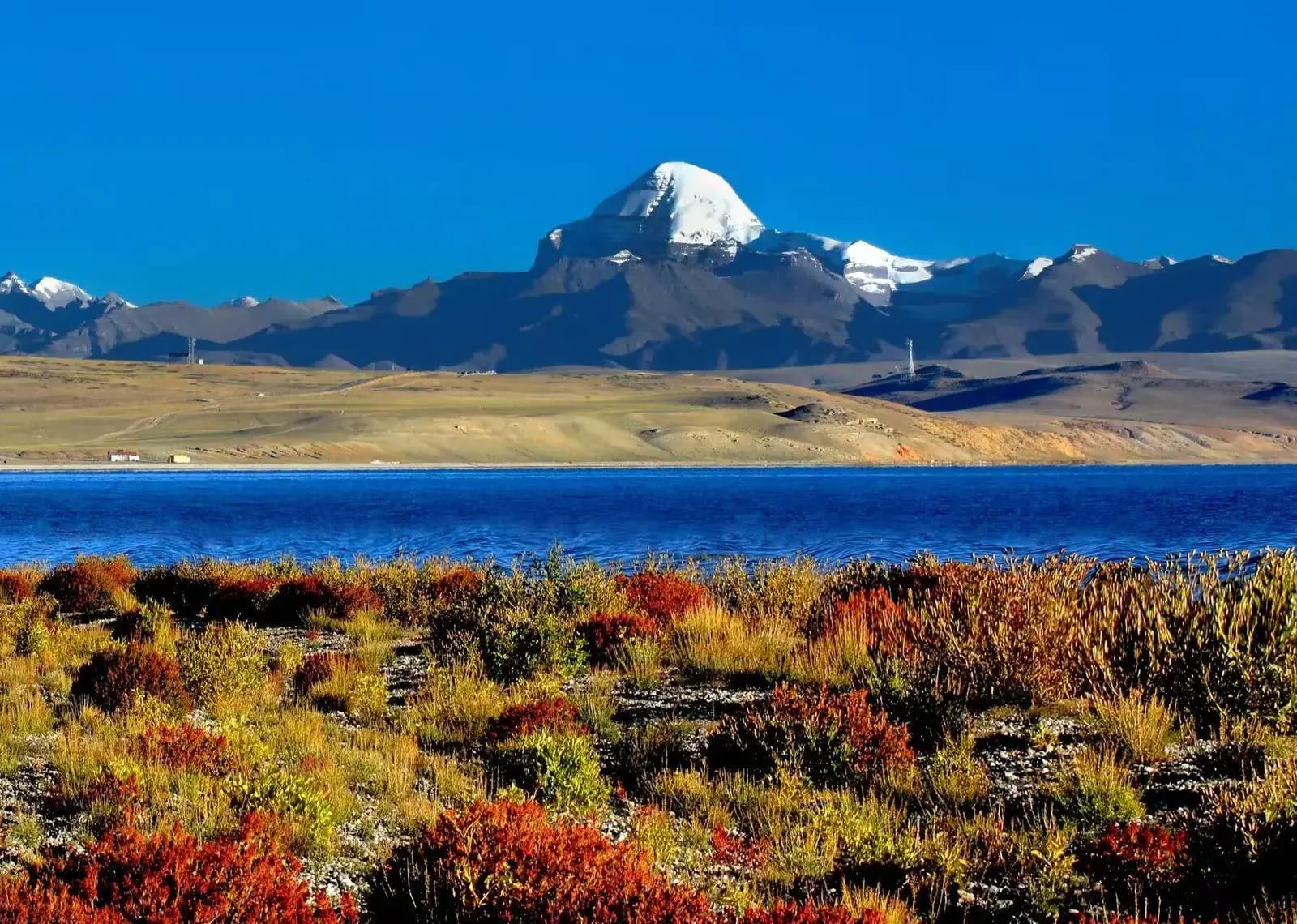
Lake Manasarovar — Source of Divine Waters
Located just 20 kilometers south of Kailash, Lake Manasarovar (4,556m) is one of the highest freshwater lakes in the world. Its crystalline waters reflect the sacred peak like a mirror to heaven.
According to Hindu belief, the lake was born from the mind of Lord Brahma — hence its name "Manasarovar" (the lake of the mind). Bathing in its waters is said to wash away the sins of a hundred lifetimes.
In Buddhism, it is called Mapam Yumtso (the Unconquered Turquoise Lake) and is identified with the legendary Anavatapta Lake — where deities and Buddhas come to bathe.
Hindu pilgrims perform sacred bathing rituals in the lake, believing its waters purify body and soul. The circumambulation of the lake (approximately 90 km) is also considered highly meritorious.
4,556m
Elevation
90km
Kora Distance
320km²
Surface Area
Lake Rakshastal — The Dark Mirror
Beside the sacred Manasarovar lies its opposite — Lake Rakshastal (4,575m), known as the "Demon Lake" or "Lake of the Rakshasa." Unlike Manasarovar's fresh waters, Rakshastal is a saltwater lake with no aquatic life.
In Hindu mythology, this lake was created by the demon king Ravana, who performed severe penance here to please Lord Shiva. The stark contrast between the two lakes — one life-giving, one barren — represents the eternal duality of existence.
A narrow channel called Ganga Chhu connects the two lakes. Local belief holds that when this channel flows, it signals an auspicious time — a rare union of the sacred and the profane, light and shadow.
4,575m
Elevation
Salt
Water Type
250km²
Surface Area
The Unconquered Summit
Why Has No One Climbed Mount Kailash?
Thousands have summited Everest, the world's highest peak. Yet Kailash, at 6,656 meters, remains unclimbed. The reasons go beyond religion — encompassing geography, mystery, and profound spiritual respect.
Perfect Pyramid Shape
Kailash possesses a near-perfect pyramidal form — symmetrical on all four sides with sharp, precise angles. Some researchers argue this geometry could not have formed naturally. Its four faces align almost exactly with the four cardinal directions, as if designed by an intelligence beyond our understanding.
Mysterious Swastika Mark
On the southern face of the mountain, a naturally formed giant swastika symbol is clearly visible — a sacred emblem in all four religions. In the golden light of sunrise and sunset, it glows with an ethereal radiance, as if the universe itself has signed this mountain as holy ground.
Respect for Billions of Faithful
The faith of billions of adherents across four religions is intertwined with Kailash. Setting foot on the summit would be an immeasurable affront to their deepest beliefs. The Chinese government has officially banned climbing, recognizing the mountain's unique status as a global sacred site.
Those Who Tried
A History of Unsuccessful Attempts
In 1985, legendary mountaineer Reinhold Messner — the first person to climb all fourteen 8,000-meter peaks — was granted permission to climb Kailash. After arriving at the mountain and understanding its profound sanctity, he voluntarily declined to attempt the ascent.
In 2001, a Spanish climbing team received permission from Chinese authorities. However, following an international outcry from religious organizations including Hindu, Buddhist, and Jain communities worldwide, the permit was swiftly revoked.
The mountain's unique near-vertical faces and perpetually icy conditions also present extreme technical challenges. But ultimately, it is not the physical difficulty that keeps climbers away — it is the universal recognition that some places are sacred beyond human ambition.
The Mystery of Kailash
Axis Mundi — Kailash is equidistant from the North Pole, Stonehenge, and Easter Island. Some researchers believe it sits at the Earth's magnetic center, forming a planetary energy grid.
Pyramid Hypothesis — Russian researchers have proposed that Kailash is not a natural mountain but the remnant of an ancient super-civilization — a massive, precisely oriented pyramidal structure.
Time Distortion — Pilgrims and researchers report unusual experiences during the kora: time seems to accelerate, hair and nails grow at nearly double their normal rate, and watches occasionally malfunction.
Divine Energy Field — Numerous yogis and meditators have reported experiencing profound states of consciousness at Kailash. An invisible energy field is said to surround the mountain, amplifying spiritual practice.
Legend and History
Milarepa's Legend — The Race for Kailash
The most famous legend surrounding Mount Kailash is the epic competition between the Buddhist yogi Milarepa and the Bön priest Naro Bonchung — a battle of spiritual power that determined the mountain's religious destiny.
Milarepa
The Great Tibetan Yogi (1052-1135 CE)
Milarepa (also spelled Milarapa) is Tibet's most beloved poet-saint and one of the greatest spiritual figures in Buddhist history. After a youth marked by tragedy and revenge through black magic, he sought redemption under the great master Marpa, enduring unimaginable hardships to purify his karma.
Upon attaining enlightenment, Milarepa wandered the Himalayan wilderness as a yogi, composing spontaneous songs of realization. When he arrived at Kailash, he found it dominated by the Bön priest Naro Bonchung. What followed became the mountain's defining legend.
Milarepa is believed to be the only person to have reached the summit of Kailash — not by climbing, but by using his meditative powers to fly directly to the peak. His disciple Rechungpa attempted to follow but was driven back by a storm of falling rocks.
The Great Competition
A Battle of Spiritual Powers
When Milarepa arrived at Kailash, Naro Bonchung, a powerful Bön priest, challenged him. They agreed to a contest: whoever reached the summit first would claim Kailash for their faith.
At dawn, Naro Bonchung began physically climbing the mountain with great speed and skill. Milarepa, however, simply sat in meditation. As the sun rose, Milarepa flew on a ray of sunlight directly to the summit, arriving long before his rival.
Defeated and awestruck, Naro Bonchung conceded. Milarepa, in his compassion, did not banish him. Instead, he granted Naro Bonchung a nearby mountain — Bonri — for Bön practitioners to worship, and decreed that Bön followers could continue circumambulating Kailash, but in their traditional counter-clockwise direction.
After his victory, Milarepa is said to have left a footprint on a prominent rock near the summit, visible to this day to those with pure vision.
The Legacy
This legendary contest represents the historical transition of Kailash from a primarily Bön sacred site to a Buddhist one — yet Milarepa's compassionate settlement ensured that both traditions would coexist at the mountain. To this day, Buddhist and Hindu pilgrims walk clockwise, while Bön practitioners maintain their ancient counter-clockwise kora, each honoring the mountain in their own way.
2026 · A Special Year
The Significance of the 2026 Horse Year
In the Tibetan calendar, every 12 years brings the Horse Year — the most sacred time for Kailash pilgrimage. 2026 marks this extraordinary year, when one kora equals the merit of thirteen.
What Is the Horse Year?
According to Tibetan astrology, once every 12-year cycle, the Horse Year arrives — a year intimately connected to the origin of Mount Kailash itself.
It is believed that Kailash was formed during a Horse Year, and Lord Shiva chose this mountain as his eternal abode in the same year. The mountain's spiritual energy is said to be at its peak during this time.
During the Horse Year, one circumambulation of Kailash earns the merit of 13 koras performed in ordinary years. For this reason, the number of pilgrims during a Horse Year multiplies several times over.
Why Visit in 2026?
The 2026 Horse Year arrives with special astronomical alignments that amplify the spiritual significance of this already sacred year.
The Saga Dawa Festival (Buddha Purnima) falls within this period, marking the most sacred day in Tibetan Buddhism — a day when meritorious deeds are multiplied millions of times over.
Since the last Horse Year (2014), this represents 12 years of waiting. The next Horse Year will not arrive until 2038. 2026 is the opportunity of a lifetime — do not miss this sacred window.
The best time to visit is from May to October, when weather conditions are most favorable for the high-altitude trek.
13x
One Kora Equals
Thirteen Koras of Merit
12
Year Cycle
Next Horse Year in 2038
May-Oct
Best Season
Ideal Trekking Weather
🐎
Horse Year Power
Time of Transformation
Cultural Traditions
Kora Traditions and Sacred Customs
The Kailash kora is not merely a trek — it is a centuries-old spiritual tradition where every step holds meaning, every action carries significance, and the journey itself becomes a moving meditation.
Kora (Circumambulation)
The most important ritual is walking around the sacred mountain. Buddhists and Hindus walk clockwise (sun-wise), while Bön practitioners walk counter-clockwise. The standard three-day kora covers 52 kilometers at extreme altitude, circling the mountain in an act of devotion.
Full Prostration Kora
The most demanding form of pilgrimage — devotees perform full-body prostrations every two to three steps along the entire 52-kilometer circuit. This takes 2-3 weeks to complete and represents the ultimate surrender of ego and complete devotion to the sacred mountain.
Prayer Flags (Lungta)
At Drolma La pass and other sacred points along the kora, pilgrims hang colorful prayer flags known as Lungta (Wind Horse). As the wind carries the blessings printed on these flags, they spread mantras and prayers for the benefit of all sentient beings across the world.
Mani Stones
Throughout the kora path, pilgrims encounter and create piles of stones inscribed with the mantra "Om Mani Padme Hum." Pilgrims place stones for their family members, leaving blessings for future travelers and adding their prayers to the collective spiritual energy of the path.
Old Garment Offering
At Drolma La pass, pilgrims leave behind old clothing, a lock of hair, or a drop of blood as a symbolic offering. This ritual represents a symbolic death and rebirth — shedding the old self and emerging renewed, having crossed the spiritual threshold of the highest point on the kora.
Sacred Bathing
Bathing in the waters of Lake Manasarovar is believed to cleanse all sins and purify the soul. Despite the icy, bone-chilling temperature of the high-altitude lake, pilgrims immerse themselves with devotion, and many carry the sacred water home in bottles as a blessing for loved ones.
Voices of Wisdom
Great Thoughts on Kailash
Through the centuries, spiritual masters, philosophers, and pilgrims have spoken of the profound mystery and transformative power of Mount Kailash.
"Kailash is not just a mountain. It is the physical form of the soul of this planet. When you walk around it, you are walking around yourself. The circumambulation of Kailash is a journey into your own innermost nature."
Sadhguru
Indian Yogi and Spiritual Master
"Mount Kailash is one of the most sacred places on this planet, where heaven and earth meet. Its sanctity cannot be captured in words — it must be experienced directly, with an open heart and a humble spirit."
Dalai Lama
Spiritual Leader of Tibetan Buddhism
"If we go beyond science, Kailash is the center of the universe — not only in a spiritual sense, but in a physical sense as well. It stands as a testament to the greatness that humanity can aspire to."
Swami Vivekananda
Indian Philosopher and Spiritual Leader
Experience the Sacred Culture of Kailash
Join the pilgrimage in the sacred 2026 Horse Year. Learn about the kora routes, prepare for the journey of a lifetime, and become part of a spiritual tradition that has endured for millennia.